Healthcare platform
Elephant In The Room
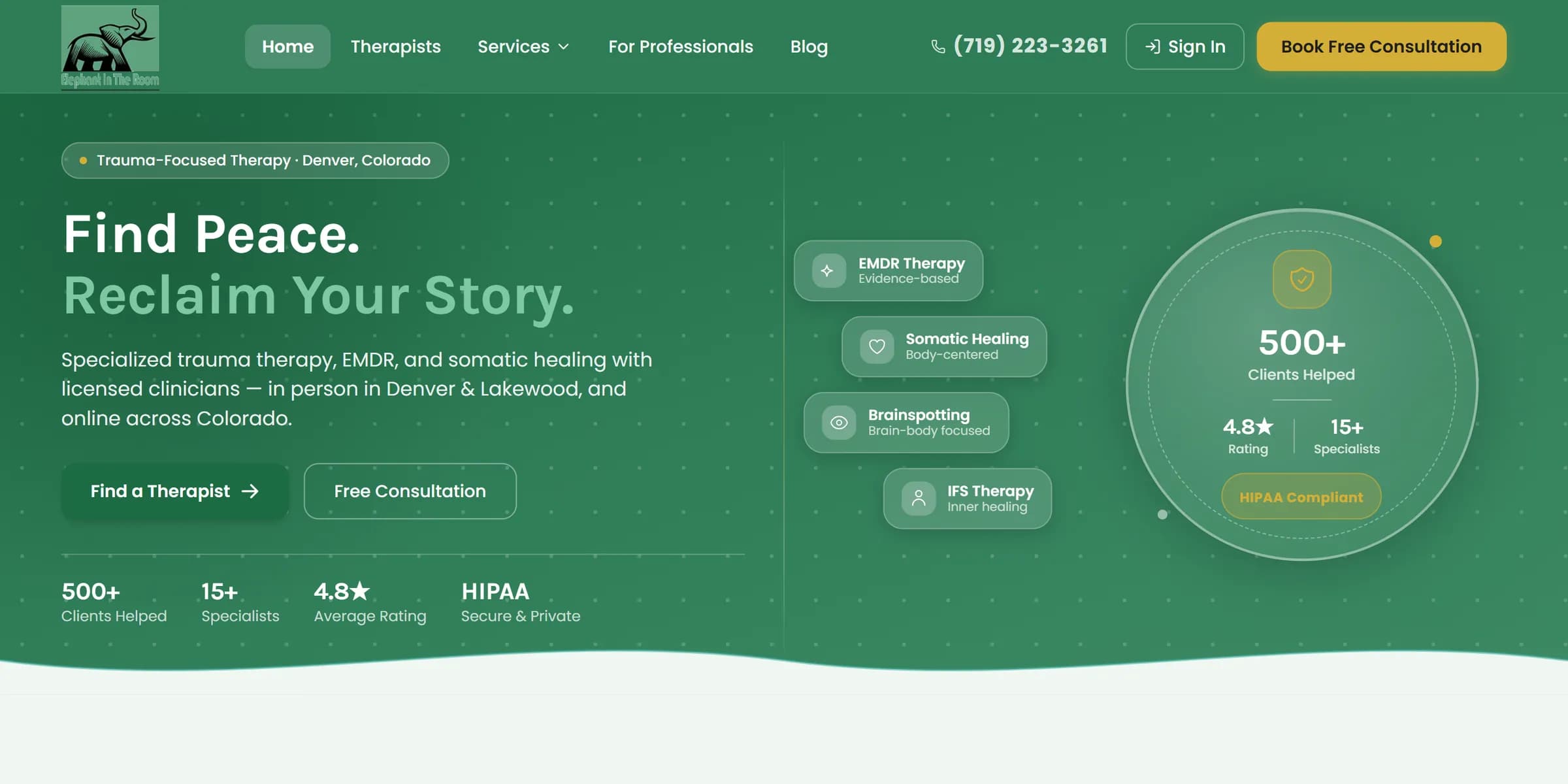
A website and booking platform for a trauma and EMDR therapy practice in Colorado — built so people in a hard moment can find the right therapist, understand the costs and book a free consultation in a few calm steps.
- Client
- Elephant In The Room LLC
- My role
- Full-stack development & SEO
- Status
- Live
- Stack
- Next.js
- TypeScript
- Express
- Prisma
- MongoDB
- Monorepo
The challenge
What the business needed
Someone looking for trauma therapy is often anxious before they even pick up the phone. The practice needed a website that feels safe and quiet, answers the money question honestly, and makes it easy to find a therapist who fits — by location, specialty, method and availability.
Behind the scenes, the practice also needed to manage dozens of clinicians, service pages and articles without calling a developer for every change — and to win back visibility in search for the treatments people actually look for, like EMDR in Denver.
What I built
The main features
Therapist directory
Search and filter clinicians by city, specialty, therapy method, day and time — with a map and clear “bookable online” labels.
Clinician profiles
A profile page for every therapist with credentials, focus areas and how they work, so people can choose with confidence.
Free consultation booking
A calm, step-by-step booking flow with live availability that shows times in the visitor’s own time zone.
Service & location pages
A dedicated page for each therapy — EMDR, Brainspotting, CBT and more — written for the Denver and Lakewood area.
Insurance & fees clarity
Accepted insurance plans and self-pay prices up front, so cost is never a surprise.
Blog & content management
An article library with search, plus a dashboard where the team manages clinicians, services and posts.
Privacy-conscious by design
JWT sign-in, a role-based admin dashboard and encrypted patient data — with consent built into every form and booking.
Privacy-first analytics
Conversion tracking that measures what matters — consultation requests — without collecting more than needed.
Screens
The live site
Screenshots of public pages, taken from the live website. Select one to enlarge. Clinician details are blurred for privacy.
Tech stack
What it’s built with — and why
- Next.js (App Router)
- Fast, server-rendered pages that search engines and AI crawlers can read in full.
- Express API
- A separate API for bookings, clinicians and content keeps the business logic in one place.
- Prisma + MongoDB
- Flexible clinician profiles and content with type-safe queries.
- Monorepo
- Website, dashboard and API share types and ship together.
SEO & performance
Getting found
Search visibility had slipped, so I treated SEO as a recovery project rather than an afterthought: fixing technical issues first, then rebuilding how each page describes itself to Google.
That meant a title and description strategy for every service and location page, structured data so search engines understand the practice, its services and its FAQs, and regular Search Console analysis to see what people searched for and where pages fell short.
I also prepared the site for AI search: clear, crawlable facts about who the practice is, where it works and what it treats — so assistants like ChatGPT and Perplexity can describe it accurately.
- Technical SEO fixes
- Title & meta strategy
- Structured data (MedicalBusiness, Service, FAQ, Breadcrumbs)
- Search Console analysis
- Local service pages
- AI-search readiness
Outcome
Where it stands
The practice now has a site that does real work: people can find a therapist, see what it costs and book a free consultation without picking up the phone, and the team can keep everything up to date themselves.
Client project — source code is private. I share what the business needed, what I built and how. The code belongs to the client.
Let’s see what your website could be doing for your practice.
Send me your website for a free check. I’ll look at how people find you and how easy it is to book — and reply with a short, plain-English summary.